Progress??
Is Progress Progress?
.
.
.
.
.
.
.
Is Progress Progress?
There is a belief that innovations are necessarily improvements and this is particularly true
of technical changes in the bike game. However, just as in economic life, new technology
tends to increase inequality, so in cycle sport new developments tend to detract from the
riders themselves. The use of radios is an obvious example: in the past a winner could
claim credit for using his own knowledge and ability to read the race, whereas now he has
usually followed the instructions of his DS.
In terms of equipment most assume that if a new bit of kit works better than its
predecessor, then it must be good for the sport. Leaving aside the question of cost, the
most famous example of the opposite view is Henri Desgrange’s refusal to allow the use of
dérailleurs in ‘his’ Tour de France, which he maintained until he fell ill after the 1936
edition. His argument was that the race should be ‘man against man’ and that complex
new equipment would confuse the issue, so making the race itself less interesting.
It is impossible to deny that there was at least a grain of truth in this idea, even though it
was doomed not to outlast Desgrange himself. The following paragraph is taken from
Raymond Huttier’s ‘Le Cyclisme’, published in French in 1947 (my translation). It gives an
insight into the practice of pre-dérailleur racing:
In the past, when it was necessary to make a choice of a single gear which had to serve
at the same time for the flat, the hills (up as well as down), tarmac, cobbles, wind,
accelerations and the final sprint….it can easily be understood that the business
demanded deep thought. It often happened that some of the great champions, such as
Henri Pelissier and Girardengo, would delay making a decision until the very last moment,
coming to the start line with a handful of sprockets. Only after a final inspection of the sky
and test on the wind strength would they fit the desired gear. I’ve seen this done many
times. In this way these master roadmen give themselves the best chance of success and
what’s more, strike a theatrical blow against the morale of their adversaries.
It has often happened that the evening before mountain stages of the Tour de France
experienced riders would publicly tell their mechanics what gear to put on for the next day
then secretly, in the shelter of their bedroom and away from prying eyes, put on a
completely different set of sprockets. The bike would then spend the night at the foot of
their bed.
This trick of the trade would wrong foot the lesser men, those whose knowledge of their
metier was imperfect or those, let us say, not clever enough to find the best gear for
themselves.
Desgrange was criticised for being a stubborn dinosaur, but did his management damage
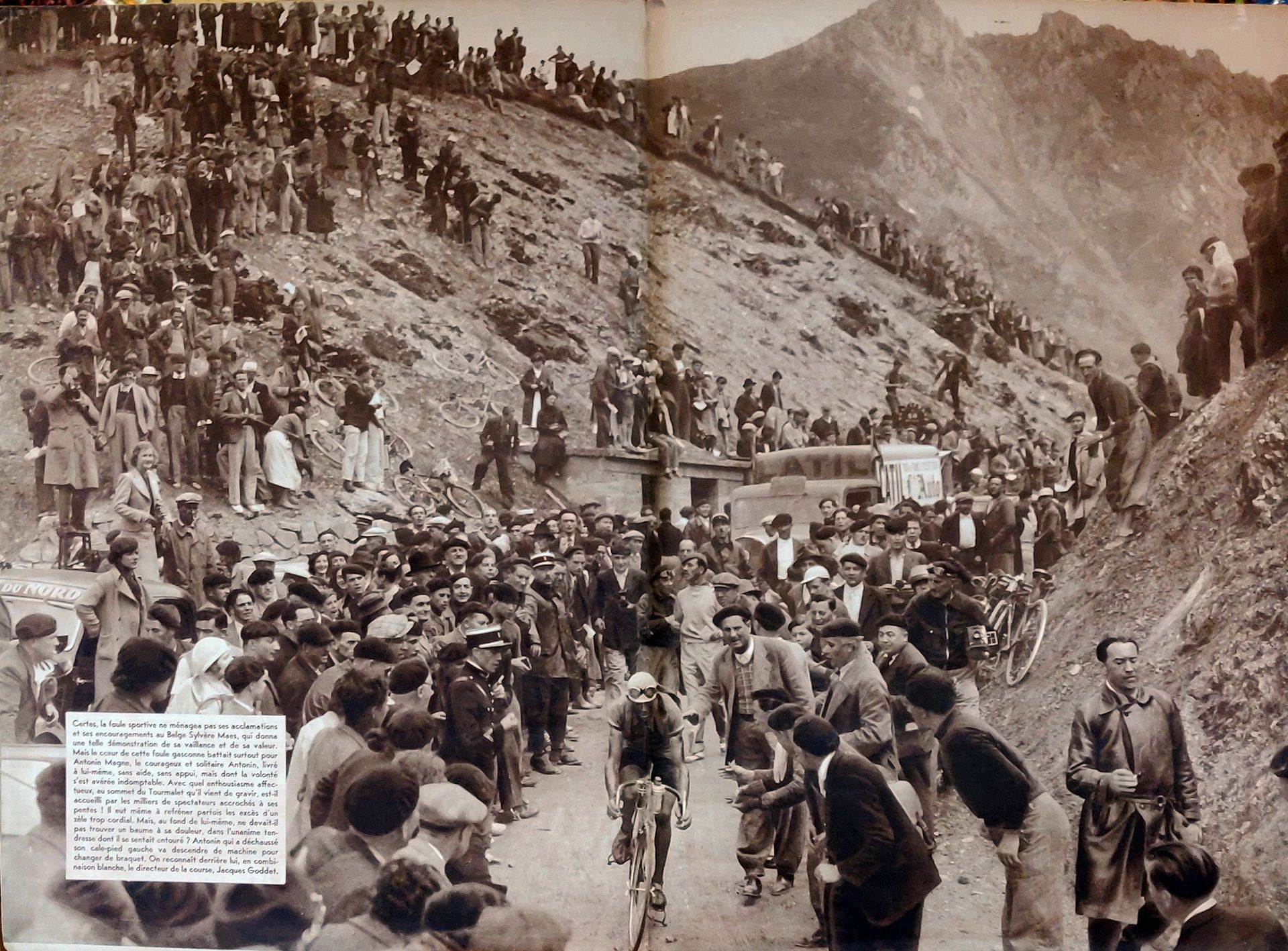
the popularity of the event? This photo shows Antonin Magne (the leading French hope)
reaching the top of the Tourmalet in the 1936 tour – he is about to dismount to turn his
wheel to get a bigger gear for the descent. Just look at the crowd and think how difficult it
must have been then to reach that bleak summit. Note that many have arrived by bike, but
it’s the enthusiasm of the crowd which is striking. While there’s no suggestion that variable
gears killed the sport, it’s obvious that there was an abundance of passion without them.
The question now must be that as more and more tech takes cycling further away from the
activity we know and love, can the sport retain its relevance and survive?
Chris Lovibond, January 2026.
Contact Us