Cycling saved my life’ – from fleeing Taliban at 16 to refugee Olympian
Sam Munnery • July 20, 2024
Amir Ansari escaped Afghanistan for Europe via car, boat and a 16-hour walk in the snow, before finding a home in Sweden and a passion for the saddle. Now, he’s heading to Paris
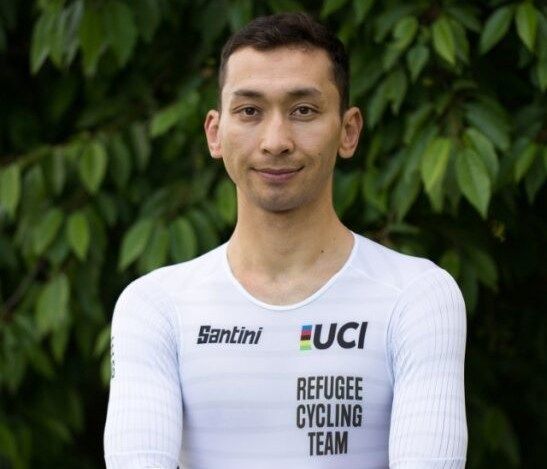
For the world’s best time-trial cyclists waiting on the Olympic starting ramp on the Esplanade des Invalides next Saturday, the flat 32.4km journey ahead of them is a potential road to gold and glory. Some have ambitions for a medal; for a few of the 35 contenders, only the Olympic title will be good enough. For one rider, though, the real achievement is just being there at all.
Amir Ansari knows what it’s like to fear for his life: being a passenger in a speeding, overcrowded car, aged 16, as he began his perilous journey from Afghanistan to Europe; fleeing police on the Iranian-Turkish border; falling into the sea while trying to reach Greece, despite not being able to swim. Born in Iran, raised in Afghanistan among the persecuted Hazara people, and now forging a new life in Sweden, his story is multinational — but for the latest chapter in Paris, he will ride in the colours not of a nation but of the IOC’s refugee team.
The 36 refugee athletes share a history of upheaval, of seeking safety, of starting again for a better life. For Ansari, it is also a sense of identity. “To represent 110 million refugees around the world, it’s a big honour,” the 24-year-old says. “I already have won my race to be there.”
Cycling is another part of his identity. It has been his ticket to the Paris Games and his life’s companion, from his school days in Kabul, through the darkest moments as he tried to settle in Sweden, and then helping him learn the craft of an elite rider.
Ansari is of Hazara ethnicity, one of the most persecuted groups in Afghanistan
His first bike, he recalls, was “one of those classic heavy bikes from China with no gears”, battling the chaotic roads of the Afghan capital. “I chose cycling because it was faster than other options,” he says. “It was just a hobby from the beginning, riding to school and back, and for fun with my friends.”
Life in Afghanistan for the Hazara community, though, was — and is — perilous. One of the country’s most persecuted ethnic groups historically, they make up about ten per cent of the population. “Because of my ethnicity we were targeted a lot — in the street, in schools, at wedding rooms, everywhere,” he says. “The Hazara people were targeted by the Taliban, Islamic State and even the government was not so kind — not protecting you, at least.
“We had no safe places travelling between cities. Your car could be stopped just because you were Hazara. In 2015, [the Taliban] stopped a car in Ghazni and killed nine people including a nine-year-old girl. It happened a lot.”
When Ansari, the eldest of four children, reached 16, a decision had to be made. “My mum decided that I had to try [to leave] — if you want to die it’s better to die trying [for a better life], not to stay here waiting for your death,” he says. “So we decided to send one of us — the person who was stronger and who had the best chance to arrive somewhere else.
“It was tough at the beginning to be leaving your family at 16. But young people in Afghanistan have an understanding about the situation, they have faced a lot of things in their lives, so you have to accept it and try to protect your family, especially when you’re a boy and the oldest child. It’s your responsibility to do something.”
His journey began in Kabul, from where he was driven, at speed, across the border with Iran in a car “for four people but they put 15, 16 people in. If you crashed everyone would die”.
In Tehran, the Iranian capital, the refugees were sold to the next people smuggler to go to the Turkish border, where they waited “for maybe a week, in a house with no windows, just one door that was locked from the outside”. There was a 16-hour walk in the snow in a pair of trainers. “If the border police catch you, they’d deport you back to Afghanistan, so the fear means you’re not thinking about the conditions.”
It went on, sliding down hillsides to escape police, a bus through Turkey to Istanbul using fake papers, and then to the coast to cross to the Greek island of Lesbos in the middle of the night. “The boat was for like ten persons, max,” Ansari says. “But there were 30 people. But [the smugglers] didn’t care — you have no choice. You can go back and the police will catch you, or you jump in and you might die.”
As they neared the shore, the boat was punctured by someone on another craft and Ansari fell into the water “which was scary because I couldn’t swim”, but somehow he made it ashore and, eventually, to the refugee camp of Moria.
Through it all, Ansari admits he had no idea where he was going but a pact struck with two other refugees of his age in Turkey led them to head for northern Europe. “I didn’t know anything so thought, ‘I’ll go with you and see where my destination is,’ ” he says.
And so he arrived in Sweden — first to Malmo and on to Stockholm, the capital. Thousands of miles from his family and home, in an unfamiliar city, one of Ansari’s first thoughts was cycling and in a Facebook search for “cycling in Stockholm” he found a name. “The same as mine: Amir. I dropped him a message explaining I was from Afghanistan, I came here as a refugee.” Invited to a spin class, he impressed so much he was introduced to Stockholm Cycling Club.
With his immigration status uncertain, and unsure if his journey would be for nothing, cycling became Ansari’s salvation. It kept him alive.
“It helped me a lot. I was so stressed,” he says. “I had a deep depression, because of my situation, waiting to hear from the immigration office. The only thing I could do was ride my bike outside for a couple of hours and just vanish everything from my mind, not thinking about my situation and doing something I love.
“That’s why I can say cycling saved my life. In 2017 and 2018 there were a lot of people my age that took their own lives because of their situation. If they deport you back to Afghanistan you could die, so I think that’s why a lot of those [suicides happened].
“I didn’t want to do that and cycling was the only way I could focus on something else and not think about suicide and my situation.”
Ansari’s early days at Stockholm Cycling Club were with the sportif riders rather than the elites, but, as his manager and coach Pierre Moncorgé remembers: “He was winning races straight away.” In one early race, Ansari didn’t know it was a 160km course, “so after 90km I just went off solo, I didn’t know how long until the finish, so ended up riding 70km alone to the end. After that the team looked at me like, ‘Have you an engine in your body?’”
• Paris Olympics 2024 full schedule: day-by-day events and timings
By the end of 2016 he was riding with the elite group, and he began learning the craft of high-level racing the following year. “He was a very fast rider but still had a lot to learn,” Moncorgé, a former professional rider, says. “He was a very punchy rider but had a hard time managing his energy over four hours of racing so often would burn himself too early. So there was a lot of learning tactics, patience, managing energy levels.”
Ansari’s results improved. He came 21st in the Swedish national time-trial in 2019; two years later he was ninth. His lack of official documentation held him back, preventing him travelling out of Sweden to train or race, but that changed in 2022 when he received a temporary residency permit. A training camp in Italy followed and, last year, the chance to represent the refugee team of the UCI — cycling’s global governing body — at the World Championships in Glasgow.
“My dream was to be a professional cyclist and it didn’t quite come true because of my situation but for those two weeks I was with the UCI cycling team I felt like a pro cyclist,” Ansari says. “We had a mechanic, a physio, a coach.” In a time-trial field of 78, he came 56th, ten minutes behind the winner Remco Evenepoel, but crucially he was the first of the two refugee riders, earning him his place at the Olympics.
Ansari doesn’t have the speed of Evenepoel and his ilk — don’t expect to see him on the podium in Paris — but Moncorgé says his charge has a rare toughness, forged by the many hardships of his life so far, that marks him out among other elite cyclists.

London Academy: Hope Inglis's team, which won the 2026 British Women's Team Cup title following the Maria Thompson Memorial race. Brother UK - On Form: Ellen Inglis's competing domestic cycling team.
80 Miles at 80